
- January 7, 2026
- Admin
- 0
NIGERIA’S AMERICAN ROMANCE, AND THE DON-ROW DOCTRINE OF ASSET LIQUIDATION
INTRODUCTION
The current grand scene of international relations has shifted outrageously- the US's Repo-Man approach to international relations. Imagine a world where countries are like cars, and
the US is the repo-man, swooping in to take what' ever they consider “theirs", when interest/instalmental payments are missed. Sounds wild, right? That's the situation with the US invasion of Venezuela on January 3rd, 2026, and it could easily be Nigeria's story too, especially with our current romance with the US on counter-insurgency efforts.
Here's the deal: Nigeria's has resources, and the US wants them. If we're not careful with our current unrestrained bloated government recurrent expenditures, borrowings/deficit financing, and unnecessary reliance on IMF and World Bank prescriptions, the US could easily use our current joint war on Insurgency, to treat Nigeria like Venezuela on the event of loan default - like a distressed asset waiting for a takeover. The US's actions in Venezuela
should be a wake-up call for us. We are dancing with the tiger, hoping it'll be gentle, but what if it isn't? We need to wean ourselves off foreign "partnerships", loans, and start taking our sovereignty seriously. It's time to diversify, invest in ourselves, and stop relying on others to save us.
Our resources are worth more than just a quick fix; let's make sure we're protecting them for the long haul. We should consciously avoid a scenario where we give the opportunity for countries or multilateral institutions, to use the current global economic imperialistic narrative to paint Nigeria's natural resources as the "unrecovered property of the external powers/creditors."
DON-ROW DOCTRINE – WHEN THE LANDLORD STOPS ASKING FOR RENT
The best phrase capturing this new "paradigm" based in the Americas and beyond is the "Don-Row Doctrine", which appears modern, but is a cynical evolution of the early 19th-century Monroe Doctrine. Basically, while the Monroe Doctrine reigned in foreign influence in the Western Hemisphere by limiting foreign involvement so that it could "exclusively" maintain the foreign facades of state sovereignty, the Don-Row doctrine signifies the endgame: intervention moved from limited influence on certain controlled possessions. It's the geopolitical interpretation of a landlord who, tired of chasing unpaid rent through the courts, simply kicks down the door and starts hauling away the furniture.
1.1 From Regime Change to Asset Recovery: The Caracas Precedent
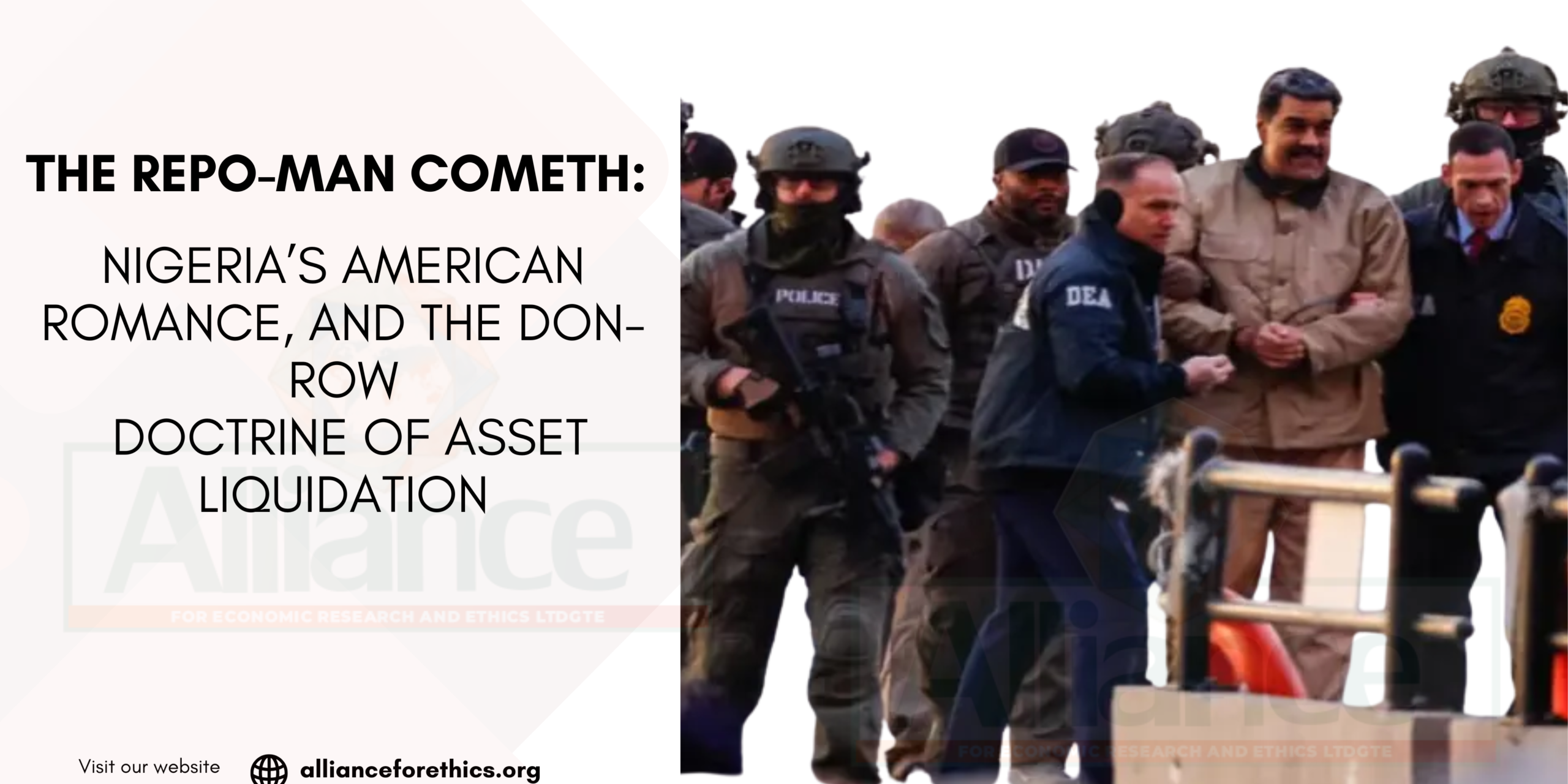
The January 2026 intervention date in Caracas serves as the original final example of this proposition. The differences in the Panama, Iraq, and the Libyan regime change offers are clear; Venezuela was the first successful "recovery operation" of US interests. Within a few hours after the arrest of President Maduro and his wife, Cilia Flores, American oil companies were already queuing up for "administrative rights" over major oil fields secured while military units and private security contractors provided raw flexibility. It signified that while the US judicial system was claiming global jurisdiction over foreign political leaders in Venezuela, it was prosecuting these foreign leaders as criminal defendants to then allow NGOs to "seize" their states' resources.
1.2 Transactional Realism: Why Natural Resources Matter More than Democratic
Ideals
Within this "transactional realism" framework, democracy promotion is viewed as an unproductive cost. Our research reflects that the hegemonic struggle for spheres of influence is coupled with the guarantee for powerful nations to exert their "rights" through force. The 2026 intervention was a message to the Global South: they are only recipients of sovereignty provided that the debtor nation "reimburses" perceived losses. This reduces complex geopolitical struggles into a
narrative of domestic law enforcement, framing the seizure of oil assets as "valuation and recovery of fungible stolen property."
1.3 Disappointment in Sanctions, Consideration of Direct Physical Control
The international community has a long history of seeking political transformation through economic sanctions. However, states like Russia and Iran have successfully established domestic stability by shifting to multipolar pathways. Emerging from sanctions, Venezuela reduced the impact of "maximum pressure" by pivoting financial networks toward Russia and China. This resilience led transactional realists to consider sanctions as "inefficient." The pivot to direct physical control of extraction points was seen as the only "rational" manner to ensure reimbursement of economic interests and restore the economic regional hegemony of the petrodollar.
RIDING THE TIGER: NIGERIA'S SECURITY ROMANCE AND FOREIGN DEPENDENCY
Nigeria is currently in the process of navigating its security landscape while "it is riding with the tiger." Our reliance on foreign military enforcement and intelligence to combat domestic security challenges has produced a structural dependency that, by definition, is anti-sovereign. We are using the tiger's teeth to fight our battles, while it seems we are aware that we may end up in the tiger's stomach.
2.1 The Military-Industrial Trap: Hardware and Intelligence
Nigeria's sole dependency on foreign military hardware (e.g., A-29 Super Tucano aircraft) constitutes a "military-industrial dependency" that acts as a tool of coercion. Transactional bilateralism means military assistance is based on loans or futures with strong strings attached. If Nigeria's policy changes, the very equipment used for national defence becomes useless without foreign technical support, spare parts, and satellite links.
2.2 Building the Moral Trigger: Justifying Intervention
The Don-Row Doctrine demands a "moral trigger" to validate the change from
partnership to appropriation. In Nigeria, violence in the North-East and North-Central is often framed by foreign actors as a Christian genocide/human rights crisis to delegitimise the Nigerian state. Once the state is determined to be uncooperative, the international "community" can begin a "recovery" of resources under the guise of humanitarian intervention.
ECONOMIC REFORMS AND 2026 BUDGET
3.1 It is of note that President Tinubu's administration current economic reforms are starting to pay off, with GDP growth hitting 3.98% in Q3 2025 and inflation easing to 14.45% in November 2025. The government's focus on macroeconomic stability- through fiscal-monetary policies, infrastructure, and human capital development are beginning to yield results, including expanded business activity in sectors like the solid minerals- boosted by reforms/improved transparency, policy on non- export of solid minerals and agricultural products without value addition, these and several other policies have improved investor confidence. The 2026 budget, themed "Budget of Consolidation, Renewed Resilience and Shared Prosperity," aims to build on these gains.
Major projects like the Coastal Highway, Sokoto-Badagry Motorway, and AKK Gas Pipeline are set to boost infrastructure, while agricultural initiatives prioritize food security through input financing and mechanization. Social interventions, including NELFUND and the Presidential CNG initiative, support education, transportation, and youth empowerment. The government overhaul of the tax system, through the enactment and deployment of the 2025 Tax Act is commendable, this will broaden the tax base and improve non-oil revenues. However, the government needs to immediately amend the Tax Act to remove the investment incentives/laws- the free trade zones and single window provisions, that were wrongly situated in the Tax Act.
3.2 With external reserves rising to a seven-year high of $47 billion, Nigeria's economic outlook looks promising. However, challenges persist, the positive impact of the reforms has been uneven, with 139 -141million Nigerians in poverty (world bank/PWC reports), partially due to the adverse effects of the reforms. The current reforms faces substantial challenges in insecurity in food-producing regions, oil price volatility, and high debt servicing costs. If reforms are sustained, with the recent pledge by Mr. President to shift to capital derisking and private sector led growth, the Central Bank of Nigeria and several analysts projection of GDP growth of around 4.49% in 2026, with inflation easing further to 12.94% may be realisable.
3.3 USD INFLOWS The U.S. dollar inflows into Nigeria's official foreign exchange market took a hit last week of December 2025, dropping by 20.67% week-on-week to $593.70 million from $748.40 million. The decline was largely driven by a significant decrease in foreign portfolio and direct investments. Foreign portfolio investment (FPI) inflows plummeted by 72.91% to $46 million, while foreign direct investment (FDI) dropped by 81.87% to just $7 million. As a result, foreign sources accounted for only 17.05% of total FX inflows, highlighting global investors' caution regarding Nigeria's macroeconomic and policy outlook.
Local sources, however, stepped in to cushion the impact, contributing 82.95% of total FX inflows. Individuals led the domestic supply with $165.1 million, followed by the Central Bank of Nigeria (CBN) with $128 million, and exporters/importers with $115.6 million. If Nigeria is to meet the above CBN positive projection on GDP growth and drop in inflation forecast in 2026, the government needs to focus on job-rich growth and human capital development towards ensuring broad shared prosperity.
THE 2026 BUDGET LIVING TIME-LOOP: A SATIRE OF FISCAL ERRORS- ANALYSIS
While the "Repo-Man" waits at the door, Nigeria's domestic fiscal management
appears more like a satire, a "fiscal Groundhog Day." The 2026 Budget is not a
framework for growth; it is a "remix" of the chaotic past characterised by
overlapping mandates and fiscal disregard.
4.1 The Great Remix: Capital Budget Overlaps
The Nigerian public service suffers from a breakdown of accountability. Analyzing the Capital Budgets of 2024 and 2025 reveals a "Great Remix" where some projects are paid for multiple times across fiscal years without completion. Some MDAs allegedly inflate budgets with duplicated projects, constructing the same road or bridge multiple years in a row.
4.2 Debt to Slavery: The Suicide Pact
Nigeria's governance cost is a "suicide pact." In early 2025, debt servicing plus
personnel costs exceeded revenue by 105%, reaching 131% in some reports. This
"debt slavery" ensures that Nigeria's economic policies are based on the needs of "Puppet Masters" in Washington and Brussels (IMF and World Bank) rather than
the needs of Nigerians.
THE NEED FOR A NEW NIGERIAN MANIFESTO
• For Nigeria to survive the Don-Row Doctrine, it needs a radical internal restructuring emphasising fiscal discipline and economic patriotism.
• Economic Patriotism: Nurturing "national champions" like Dangote and BUA to build an independent economy shielded from the FDI "Trojan Horse."
• Indigenous Governance: Moving away from "alien" Western-style structures toward indigenous models that emphasise true federalism and accountability.
• Law as Defence: Building a professional judiciary and zero-tolerance anti-corruption frameworks (strengthening NEITI) to prevent the "moral triggers"
used to justify external intervention.
CONCLUSION
The 2026 Caracas operation and the Don-Row Doctrine obliterate the last vestiges of diplomatic niceties. The choice for Nigeria is clear: restructure our economy internally, reduce cost of governance, increase transparency and build a sovereign, self-reliant nation, or be "restructured" by external powers/creditors, who view our natural resources as their "fair price" for repatriation.
Nigeria must be built by Nigerians for Nigerians; if not, we will be managed by others for themselves. Restructuring fiscal policies and reducing the dependency on external borrowing are crucial for a self-sufficient economic future.
Hon. Dele Kelvin Oye
Chairman, Alliance for Economic Research & Ethics (AERE)