
- December 30, 2025
- Admin
- 0
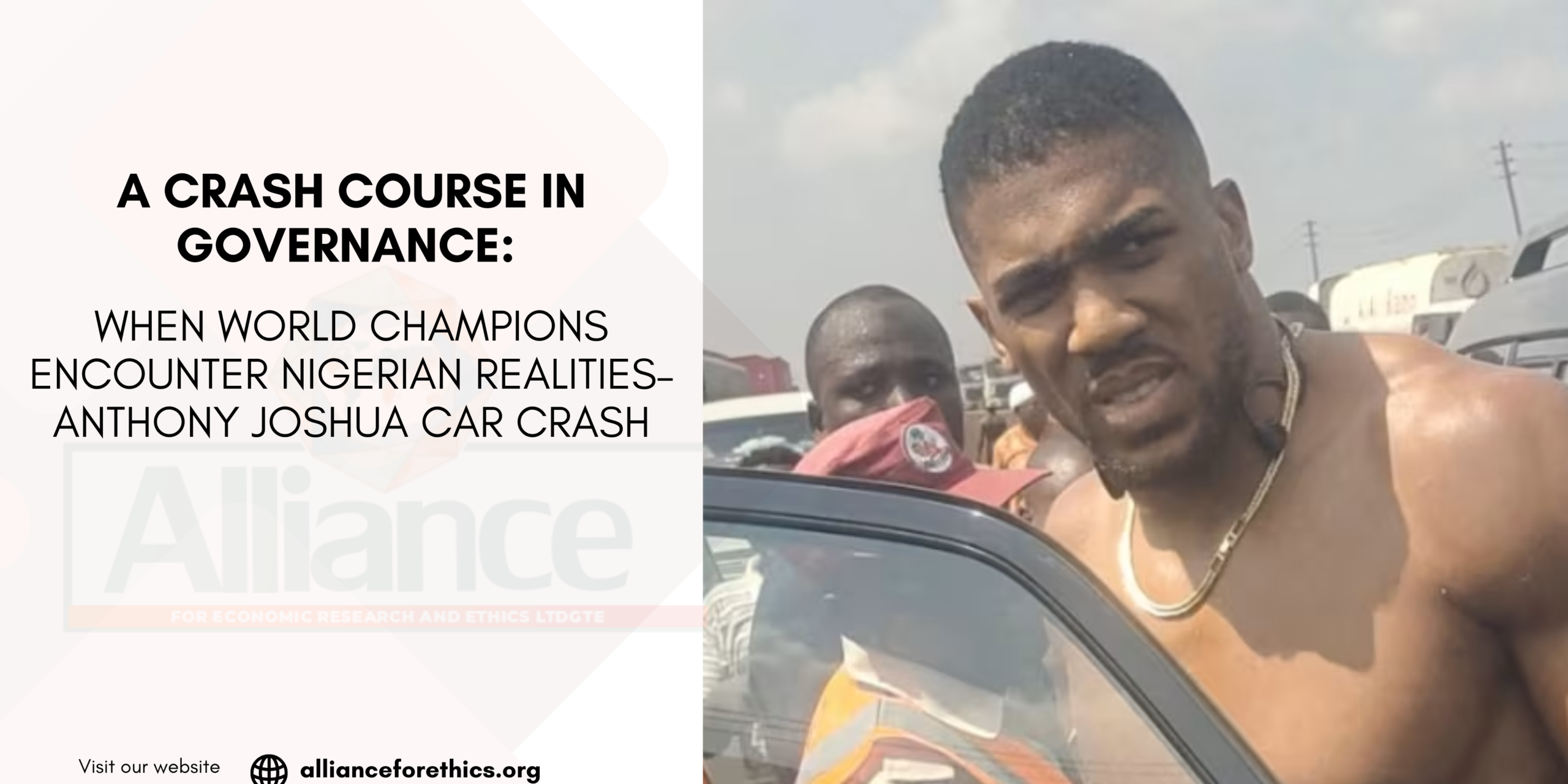
A CRASH COURSE IN GOVERNANCE: WHEN WORLD CHAMPIONS ENCOUNTER NIGERIAN REALITIES.
In a jarring incident on the Ogun-Lagos expressway on December 29, 2025, former British-Nigerian world heavyweight champion Anthony Joshua was involved in an automobile incident that tragically claimed the lives of two of his aides. Emerging photos of the scene revealed the tragic realities: a mishmash of twisted metal and other debris; the boxer’s bloodied and injured body on the roadside, glass shattered below; and an embarrassing lack of organised, official emergency management response. No ambulance service, the Federal Road Safety Corps officials present had no first aid treatment materials; only a scene of chaos from an all too familiar tragedy on a Nigerian highway fraught with danger.
Although this incident was a personal misfortune for the lives impacted, it became much more of a metaphor for the Nigerian nation. Here was Anthony Joshua, who embodies one of the best of Nigeria on the international stage, now just as vulnerable as any other citizen, suffering without any visible medical emergency equipment to support him. Joshua was not fortuitous enough to have a view of the poor services Nigeria offers to her citizens, who take the risk to travel on our pothole-filled roads. The crash was not an accident; it has matured in many respects of Nigerian decline. It manifested in the breach of the social contract Nigerians expect should be the responsibility of the state, which has been abnegated in many critical ways. Joshua's embolism was shock and would justify longer consideration, as Nigerians continue to ponder over what the realistic payments for taxes, diaspora remittances are, and if the service provided by the state is commensurate to their investment in the state.
1. The Phantom State: Taxation with No Representation (or Service)
The emotive nature of the collision above simply emphasized a profound Nigerian ambiguity—an excess of government in the official space of taxation to its ghost appearance in delivery of function, service or business. For many citizens outside the manicured, glorified areas of Abuja Central Business District, Maitama, Asokoro, in the Federal Capital Territory or Victoria Island/Ikoyi in Lagos, the Nigerian State provides an experience based on taxes, levies, and numerous forms of official and unofficial fees and tolls.
However, when crisis occurs in the form of illness or emergency situation, or risk to the individual like the Anthony Joshua vehicle accident, the same State that perfected the art of withdrawal will dematerialize at the point of delivery. This disconnect is made even more pronounced by the ongoing situation with the nation’s fiscal policy as the government readies to implement the 2025 Tax Act from January 1st, 2026. The irony is staggering. A government struggling to deliver the most basic public good is again attempting to dig deeper into the pockets of citizens.
The complexity is confounded by a crisis of confidence with regard to the Tax Act itself. Allegations of tampering and discrepancies between the version passed by lawmakers and the version in the Official Gazette forced the National Assembly leadership to order the re-gazetting of the controversial laws. This procedural shift is more than administrative; it is a metaphor for the dubiousness and disorder guiding some Nigerian policymaking, eroding the little trust that remains between the governed and the government.
Taxes and the pact they embody are matters of reciprocity—citizens pool resources to benefit from goods and services that serve the collective good.
“What happens when this pact is violated? When taxes feel less like a civic duty and more like tribute to a distant, unresponsive government?”
What follows is deep and pervasive cynicism that erodes the underpinnings of the state. Nigerians are effectively funding a parallel world where government officials enjoy state benefits while citizens toil in a landscape of institutional deterioration. This is not just an infrastructure failure; it is a moral failure of sovereignty.
2. Economic Roadblocks: Policy to the Engine of Growth
The dysfunctional social contract extends beyond crumbling roads; it creates extraordinary roadblocks across Nigeria’s economic landscape. The current approach to taxation appears punitive rather than productive, inhibiting the very growth it claims to pursue. The strategy taxes existing, often struggling enterprises into oblivion instead of creating space for new wealth. This is fundamentally unsustainable.
Economic growth is not a finite resource to be mined; it is an ecosystem to be cultivated through education, skills development, and infrastructure—best enabled through a vibrant private sector and innovative government policy, such as the Dangote Refinery example.
Nigeria’s tax-to-GDP ratio may be relatively low, but the burden on the formal productive sector is crippling. Without public investment, capital formation becomes nearly impossible. Without capital, nothing gets built—factories, businesses, or safe roads. Borrowing becomes a substitute for growth, mortgaging the future through inflation, currency devaluation, and increased taxation, trapping the nation in cycles of debt and stagnation.
3. The Diaspora Dilemma and “Detty December”
Nigeria’s diaspora is a massive economic engine. Diaspora remittances in 2025 reportedly reached $23 billion—the highest in five years—with monthly inflows peaking at $600 million and Q2 2025 hitting $5.3 billion. These inflows support the naira, household consumption, education, and small businesses.
In light of the Anthony Joshua accident, a brutal truth emerges: the diaspora is investing in a homeland they hope will thrive. When a national icon is stranded without basic emergency services, it sends a chilling message about the country’s inability to guarantee minimal protection.
This contradiction is most visible during “Detty December,” when hundreds of thousands return home to celebrate. While the season yields billions in tourism revenue, it unfolds atop systemic dysfunction—bad roads, insecurity, unreliable infrastructure. The Ogun-Lagos expressway crash is a sobering reminder that celebration can instantly turn to tragedy.
4. The High Cost of Neglect: Misplaced Priorities in National Spending – The 2026 Education Budget
Nigeria’s infrastructural decay reflects deliberate budgetary choices. The proposed 2026 budget allocates ₦5.41 trillion to defense and security, ₦3.52 trillion to education, and ₦2.48 trillion to health. This prioritization treats symptoms rather than causes.
The oversized security budget is a deferred tax on decades of educational neglect. Failure to invest in human capital creates a vacuum filled by poverty and extremism, fueling insecurity that then justifies massive military spending. Although security, education, and health are “mutually reinforcing,” allocations show reactive security spending eclipsing proactive human development.
The long-ignored Oronsaye Report (2012) proposed reducing federal agencies from 263 to 161. Its implementation would reduce governance costs and redirect funds toward infrastructure, healthcare, and education—making government leaner and more effective.
5. Towards a New Social Contract: A Message for the New Year
The mangled debris on the Ogun-Lagos expressway symbolizes a nation on the brink. Like Anthony Joshua, every Nigerian is a champion battling extraordinary odds. But citizens should not be forced to fight the state itself.
A new social contract must be built on accountability, transparency, and mutual responsibility:
Transparency: Publish detailed accounts of public spending.
Reprioritization: Focus on infrastructure, power, and safety, leveraging public-private partnerships.
Efficiency: Implement the Oronsaye Report to shrink bureaucracy.
Engagement: Establish credible mechanisms for citizen participation and accountability.
Anthony Joshua’s experience makes one truth unmistakable: wealth and status are no substitutes for a functioning state. With political will, honest policy review, and a genuine commitment to serve, Nigeria can build a nation that works for all.
Thank you.
Who We Are
The Alliance for Economic Research and Ethics (AERE) LTD/GTE is a Nigerian non-profit dedicated to strengthening Nigeria’s private and public sectors through evidence-based research, policy advocacy, regulatory support, stakeholder engagement, and ethical reforms to improve the Ease of Doing Business.