
- February 2, 2026
- Admin
- 0
Synergizing Zakat and Waqf under Nigeria’s Tax Act 2025.
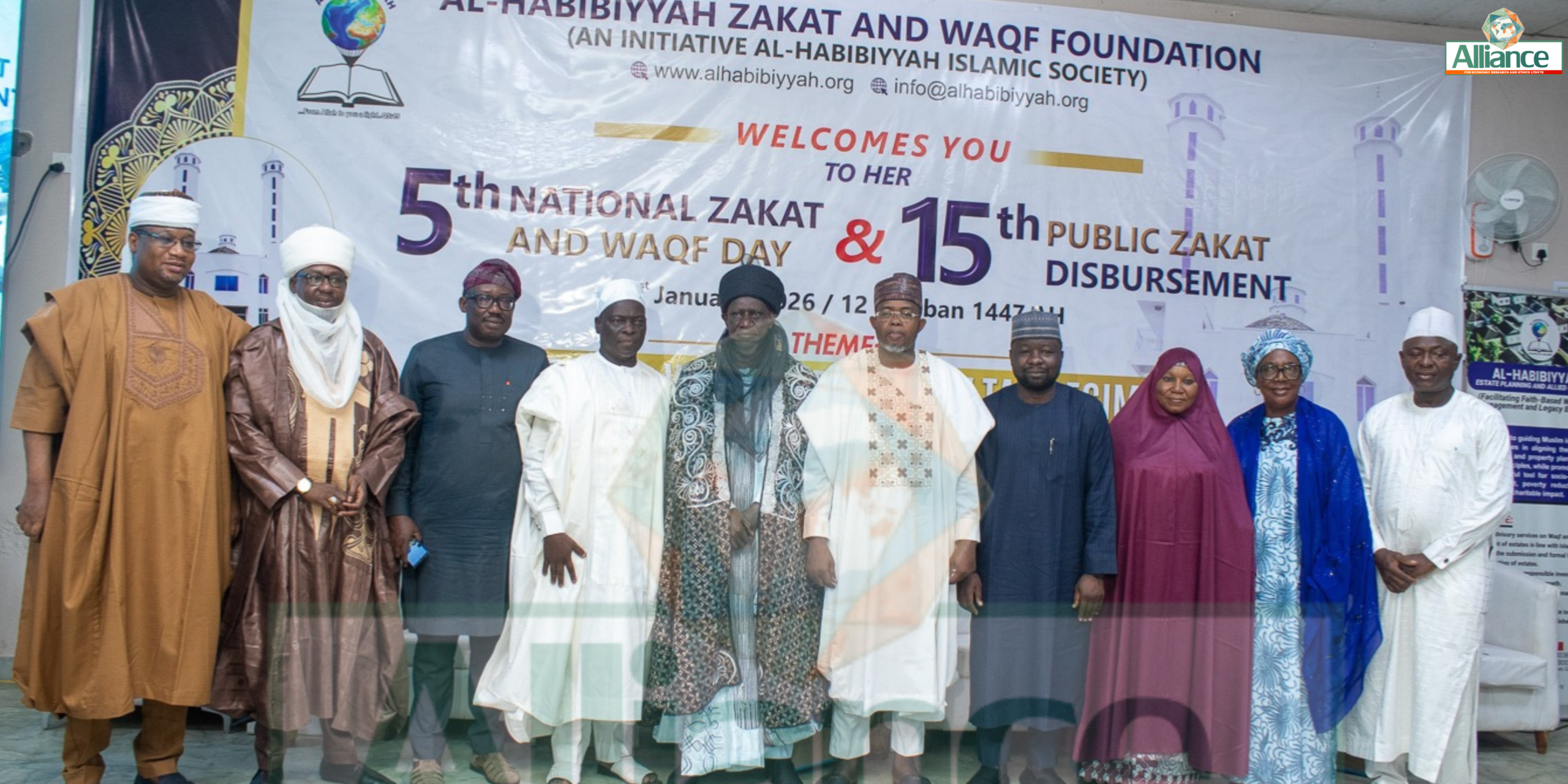
Paper delivered by Hon. Dele Kelvin Oye, (Chairman, Alliance for Economic Research and Ethics LTDGTE), at the Al- Habibiyyah 5th National Zakat & Waqf Day, held on the 31st January, 2026, at the Main Auditorium of Al- Habibiyyah Islamic Centre, Guzape, Abuja.
Abstract
The passage of the Nigeria Tax Act 2025 signifies a radical change in the country's fiscal architecture; shifting from a fragmented, multi-layered tax regime to one that is centralized and digitally integrated. While the Act is intended to streamline revenue mobilization, increase tax compliance and enhance administrative efficiency, significant friction is created for faith-based institutions, and particularly those institutions operating in accordance with Islamic finance paradigms.
This paper examines the friction between the statutory directives of the 2025 Tax Act, and the spiritual mandates of Zakat (mandatory alms) and Waqf (perpetual endowments). The use of the Cloud Unified Tax Portal for centralized tax administration, and tightening definitions of the “public character”, may inhibit the ability of these institutions to function autonomously and without drawing public attention to their fiscal transactions, especially in a multi-ethnic and multi-religious cultural context such as Nigeria. What I mean is that, the relational status between statutory law and divine law at issue is the transition from the Companies Income Tax Act (CITA) statutory framework to a new law wherein I anticipate that the Muslim (or any faith based) taxpayer may potentially face double taxation by virtue of the relational agreements that exist between the Muslim taxpayer and Allah for the giving of Zakat and the awarding of certain taxes on his income.
Lastly, as part of the research findings, I will discuss the possibility of extending the current modality of tax receipt waivers for faith-based institutions, by proposing a "Religious Social Responsibility Credit," and further propose a "Faith-State Compact" as a regulatory intervention; to compel states to harmonize statutory taxpayer obligations with spiritual obligations to fund social programs through modelling the substantive rationale for resolving a potential conflict between religious obligations, and taxpayer obligations. Ultimately, I will conclude that the successful integration or implementation of the reforms mandated by the 2025 Tax Act (NTA), will require an understanding of the faith-based financial pillars, as it relates to spiritual obligations, in a way that does not grant fiat to the notion or reasonableness for universal transparency, while acknowledging the social capital that faith-based institutions provide to a very complex social safety net.
1. Introduction
Nigeria stands at the beginning of its most significant fiscal transformation since its return to democratic governance; this by means of the passage of the Nigeria Tax Act 2025. The new law is intended to address perennial revenue challenges and chronic shortages, eliminate the embarrassment of nuisance taxes, and provide for development of tax administration through digital infrastructure. However, in a nation where the movement of finance is already precariously interdependent on religious identity, secular fiscal policy and financial obligations have compounded a complex "Double Sovereignty" dilemma. For the observant Muslim, Zakat is not only a charitable act; it is a universally understood non-negotiable covenant between the Creator and the worshipper as a Zakat or "obligatory Almsgiving". When the State issues a forced fiscal responsibility on the citizen without any consideration or accommodation of the citizen's religious obligations, it creates duality in tensions of duty to the state and duty to God.
Historically, Nigeria's assessment and collection of taxes system has turned a blind eye to religious bodies when it comes to tax exemptions, typically granting very broad exemptions under "public character" standards. The 2025 Tax Act represents an attempt to replace ambiguity surrounding religious tax exemptions with an upgraded data driven framework of public awareness and religious bodies (see s. 162(1.a[iii]) of the NTA). The 2025 tax Act significantly misunderstands the diversity of Islamic finance instruments such as Waqf by operating with the assumption of uniformity and secular modernity. Having been defined as the permanent dedication of an asset for charitable purposes Waqf has historically provided an autonomous social safety net for education, health care and infrastructure. The new rules, towards mandatory self-assessment VAT with digital donor identification will eclipse the spiritual anonymity many donors prefer to protect the dignity of the recipient and sincere intent for giving.
The economic issue is compounded by the impact of having both religious obligations and state taxes. If the state's tax-free threshold is different from the Nisab, the poorest faith practitioners may have these obligations because both obligations become too expensive for their economic experience. Moreover, with the transition to the Cloud Unified Tax Portal, it adds a high compliance cost for religious committees, which may not necessarily have professionalized accounting structures, would be unable to conduct their fiduciary responsibilities under the Nigeria Revenue Service (NRS) digital ecosystem. We are studying these frictions, to understand the nature and extent of the frictions, the impact of the 2025 reforms on Islamic finance pillars and to propose (now and in the future) strategic recommendations for better harmony with faith and the fiscus.
2. The Historical Pathway of Nigeria's Fiscal Environment: From Proliferation to Centralisation
The historic pathway of Nigerian taxation has a long history of a struggle between the need for centralised revenue and the existence of a fragmented administrative plan. With prior reforms, the Nigerian tax environment was labelled "hostile" from the multiplicity of taxes and from a non-unified interface for taxpayers. The journey to the 2025 Tax Act is essentially an assertion of the re-establishment of 'fiscal sovereignty'- a compression of various levies and reassertion of the federal government's authority over a tax base is the focus of this arrangement. However, this is not simply an administrative break, rather, it follows an existing and slightly bigger trend, with states embracing digital technology to discover the "tax gap", and retain leakages in the informal sector. Centralisation and cost efficiencies has now introduced a "one-size-fits-all" outcome.
In the Nigerian setting, a specific challenge for religious institutions has been to fill the void of the state in social welfare provisioning, and the 2025 reforms changes the relationship between the state and non-state parties. The state is no longer willing to allow religious bodies to operate in a grey area of tax exemption, and now require the documentation of their "public character" through reporting documentation. The reform indicates the end of "informal exemptions," and based on the level of scrutiny that religious organizations, will have, this suggests a shift to faith organizations operating with the same level of administrative competency of corporations.
2.1 The Old Tax Regime: Limitations of the Companies Income Tax Act
Under the CITA, the old tax regime was ambiguous concerning the taxation of religious and charitable organizations. CITA included exemptions of profits of any company (and religious organizations) engaged in ecclesiastical, charitable, or educational activities of a "public character," provided such profits are not from a trade or business carried on by the company. The term "public character" was not fully defined and many religious charity organizations were able to operate commercial businesses, such as schools, hospitals, and printing, and non-profits.
The lack of a clear definition opened up the loophole to have "prophet-profit" ventures and not have to pay an obligation while competing against taxable businesses in the process. The challenges of the old CITA scheme was especially acute for Islamic entities such as Zakat and Waqf. Zakat is, in practice, collected and distributed by local mosque committees or open foundations, and these entities are rarely, if ever, formally registered for federal or state "tax-deductible" status. As a result, donors to Zakat could not claim a tax deduction on money collected as Zakat, which in itself had become a source of, a form of double taxation: Once as a matter of state taxation and another right in the name of the religion, e.g. Zakat. The socio-economic function that did not factor into the old CITA schemes was the character of Zakat as a vehicle for "family-resilience" and poverty alleviation efforts, which the State was ignoring as an important avenue for social capital.
Waqf, by legal definition under the old CITA scheme, also had very little in terms of recognition of the perpetual trust; at a federal level most of these perpetual trusts were in regulatory limbo. While there was no direct statutory category for Waqf, in principle perpetual trusts where assets (land or commercial buildings) were dedicated to charity, all Waqf assets were regulated as ordinary corporate assets, which exposed them to Capital Gains Tax and other taxes which eroded the principal of the endowment. While the "informal" nature of the old CITA scheme indirectly provided some protection from aggressive revenue collection, it exposed religious institutions to arbitrary assessments without the protections of recognized charitable trust. The responses of the 2025 reform were to address these issues and after effects, at the cost of increasing the regulatory burden.
2.2 Key Legislative Drivers of the Nigeria Tax Act 2025 and the Tax Administration Act
The transition to the Tax Act was borne from many different critical issues, the two significant issues relate to alignment with international standards, and the urgent demand to remain sustainable in the face of declining oil revenues and the severe need to broaden the base of taxation. One of the significant drivers was the "Seven Targets 2025" framework which sought to influence a "Connecting the Unconnected" strategy which sought to fold informal sectors into a formal digital economy. The legislative push of the Tax Act was also influenced by Nigerian commitments to global initiatives, such as the Addis Tax Initiative which encouraged donor country's engagements with developing nations to onboard their tax systems & responsibilities to make them modern and transparent. The Act is historically a response to both domestic fiscal crises and external exportation of international obligations.
A complementary legislation to the Tax Act is the Tax Administration Act which enhances the capabilities of the Nigeria Revenue Service (NRS) with powers of enforcement and data collection. This Act outlined strict penalties for tax non-compliance, and also mandated electronic invoicing and real-time reporting. For religious institutions, the driver is 'transparency', which is in line with the motives of government to ensure that organizations claiming tax-exempt status improved public good and was not a vehicle for money laundering or tax evasions. In addition, the Governments reforms coincide with global anti-corruption and transactions, where the digitization of tax records have been one of the most effective tools to track illicit financial flows.
Another driver is clarifying tax policies between economic blocs, similar to the BRICS economies, where Nigeria is looking for models which embrace "good faith compliance" with legal principles. The 2025 Act adopts a model that provides for more uniform and standardized enforcement of transfer pricing assessments, to entice foreign investment into Nigeria. While a good intention in a vacuum, this push toward uniformity is counter to the Islamic legal and ethical circumstances some organizations must satisfy. The OIC (Organization of Islamic Cooperation) member countries retain specific legal designations which protect the religious sanctity of Waqf assets, which the broad-brush language of the 2025 Act concerning "non-governmental organizations" (NGOs) might still override.
2.3 The Cloud Unified Tax Portal and Digital Integration
Ultimately, the cloud Unified Tax Portal is the focal point of the 2025 reforms. The Cloud Unified Tax Portal was created to provide a single point of entry for all tax-related transactions in Nigeria. The Cloud Unified Tax portal is something new, but aligns with Nigeria's move toward using "cloud computing" to improve e-government services, and to further streamline the registration of land and asset. For the NRS, the Unified Tax portal was created for efficiency, because it can facilitate automated tax assessments, and allow real-time monitoring of VAT remittances, but for the religious organizations interacting with the portal, the Unified Tax portal sets up an automatic "transparency-anonymity gridlock." Islamic ethics often emphasize "secret giving", so as to maintain the donor's sincerity about his or her intentions, and the dignity of the recipient. Now that e-invoicing for all legitimate contributions is now the order of the day, even more so with the requirement to include a Tax Identification Number (TIN) or National Identification number (NIN), there is the potential to de-anonymize even our most spiritual acts of worship.
The digital integration services provided by the Unified Tax portal have also raised significant fears about the ethics of data privacy and cybersecurity. Now that religious institutions providing financial records and donor-sensitive information have to upload them to the cloud, they are likely to become targets for data breaches. The 2025 Act's reliance and limitations on cloud providers, leads to the potential of legal pitfalls if that provider did not handle data responsibly under the evolving regulated digital privacy laws. This is an example of zonal digitalization of management control systems, now there is another layer to that where religious leaders have to become technically competent or hire "Faith-Accountants" for their digital presence, that small Zakat committees could ill afford.
The favoured or preferential digital entry of the Unified tax Portal creates confusion to a remote or distanced form of enforcement regarding VAT on digital services to self-accounting for NGOs, and makes those who consider themselves purely spiritual, to be connected to the digital taxing chain. If a mosque buys digital equipment to subscribe to a cloud service for the work they do, they will now have to treat that expense as taxable under a "unified VAT policy for digital services," that further requires them to account for appropriate registrations and report to the NRS accordingly. This technical barrier to entry could perpetuate institutions that are not digitally competent, potentially making them involuntarily non-compliant. The digital-first tax approach rests on all institutions having the "faith in digital infrastructure" to participate. However, many traditional religious organizations view this transition as further encroachment on their spiritual sanctuary.
The 2025 Tax Act's aim at the digital economy and a domestic tax policy illustrates a global shift for when "life is about culture and religion" but the legal frameworks tend not to consider these cultural nodes in a digital format. In Nigeria, where religious values may resist the cultural changes initiated through globalization and secular digitization, the Cloud Unified Tax Portal stands for the State's effort to "connect" the "unconnected". As we contemplate the future, the question is whether the Portal can comply, with respect for the believer's "spiritual anonymity," while fulfilling the "fiscal transparency" required by the State. Without such consideration, the 2025 Act could contribute to a "religious shadow sector" whereby the believers use informal channels to satisfy their obligations, but avoiding the invasive digital eye of the fiscus to remain transparent.
3. Comparative Analysis: Pre-2025 Framework versus the 2025 Tax Act
The shift for Nigeria's fiscal architecture from a fragmented legacy conversation to the centralized framework of the Nigeria Tax Act 2025, signals a fundamental change in the state-non-state actor nexus, religious and charitable organizations will need to determine how the new tax act applies to their existing fiscal operations. The previous fiscal regime, centered on the Companies Income Tax Act (CITA), utilized an approach of benign neglect or informality through exemptions, guided by definitions of charitable purposes. In contrast the 2025 reforms will necessitate a rational and data driven approach applying comparatives to how traditional Islamic financing tools, such as Zakat or Waqf, will sit in the context of the new regulatory landscape.
3.1 New Definitions of Public Character and Charitable Activities
The Nigeria Tax Act 2025 maintains the definition of a public character organization, in comparison to the previous tax framework, religious organizations could operate under a general assumption of charitable status, unless their transactions were clearly commercial. The new framework will impose the burden of proof on the organization to prove how its status aligns with specific criteria for "public benefit" to maintain its tax-exempt status. Trend studies on the definitions of public character suggest that the state is taking a focused view of religious organizations based on a potential base erosion and anti-money laundering (AML) compliance.
The 2025 framework specifically states that for an organization to be public character, the profits must be from a public purpose activity and expressly not distributable to any person or member of the organization. This definition captures some of the spirit under the previous CITA, however the compliance regime is most assuredly changed. The Nigeria Revenue Service (NRS) has adopted Cloud Unified Tax Portal to ensure these claims are verifiable against real-time financial data. This redefinition could impose friction on Zakat committees or Waqf managers that may be legally operating ancillary investment activities (for example: leasing Waqf held property) to support primary charitable missions. Failure to properly separate commercial "for profit" from "public character" activities could jeopardize tax exemption for the entire entity.
The focus of the charitable activities will also need to be supported with evidence as the new Nigeria Tax Act 2025 reforms mean that all charitable activities must have documented evidence. This documentation creates a type of anxiety with Islamic social welfare, as many activities operated within informal community level structures. The state is concurrently engaging a less democratic structure of charitable definition as economic stimulus with transparent and broadening the tax base whereby every entity registered as operating in an economic space is accounted for.
3.2 Transitioning from Informal Exemptions to Mandatory VAT Self-Accounting
The movement from informal VAT exemptions to obligatory self-accounting VAT regime for NGOs and religious bodies, will be the most substantial resolve of the administrative changes presented in the 2025 Tax Act. Many religious bodies led by the philosophical or assumed premise of a non-profit buyer category believed their purchases/services were inherently zero rated or exempt. The Nigeria Tax Act 2025 will invalidate this assumption that religious/bodies have never been currently registered for VAT or self-accounted for any taxes to be accessed against services provided by non-residents or on goods used in not exempt activities.
This change introduces a "compliance tax" in the way of administrative burden. Now, Institutions that manage Zakat and Waqf will also have to implement somewhat complicated accounting systems to track VAT-inclusive transactions. The new VAT self-accounting rule means that if a Waqf-endowed hospital purchases specialized medical software from a foreign vendor, the hospital is now legally obligated to calculate VAT and pay it to the NRS, even if the hospital sees the poor for free. This initiative will close loopholes that allowed commercial entities to perform transactions disguised under a religious umbrella, but it also raises the operating cost of legitimate faith-based welfare service providers.
The introduction of Bank Verification Number (BVN) and National Identification Number (NIN) into the tax portal also ensures tax authority traceability of VAT transactions to individuals or trustees. For the Islamic financial space, this signifies a shift away from a "trust-based" informal economy to a "surveillance-based" formal economy. The economic effect is significant; it requires religious organisations to act as unpaid tax administrators, detracting from costs allocated to poverty alleviation, to satisfy legal obligations.
3.3 Comparative status of Zakat and Waqf under old and new legislative provisions
Zakat and Waqf have always occupied an ambiguous status in Nigerian Federal Tax Law. Under the old regime, Zakat was treated as a personal religious duty that was outside the scope of the state, but Waqf assets were sometimes recorded as simple trusts or claimed under the Land Use Act, and were not specifically recognised in their charitable perpetuity. The 2025 Tax Act, does not specifically mention Zakat or Waqf legislation in each clause, but allows the legal and regulatory environment to effectively "capture" these instruments under the broader umbrella of "Trusts and Settlements”.
Ultimately, my comparative analysis produces three major distinctions in:
- Reporting: Under the old regime, many Zakat committees declared few returns or little or no returns. The 2025 Act requires annual filing through the Cloud Unified Tax Portal, with inflexible penalties and fines for non-compliance.
- Asset valuation: The 2025 Tax Act imposes stricter rules around asset valuation. For Waqf (endowments), this means the appreciation of the value of the property must be documented, and any income arising from it must be reviewed to ensure its charitable application.
- Donor identification: While funders were able to make anonymous donations in the old system, the 2025 Tax Act emphasis on beneficial ownership ("knowledge your customer" [KYC]) and Anti Money Laundering (AML) means that large scale donations must be associated with a registered identity.
Overall, the 2025 reforms require Islamic social finance mechanisms to be "professionalized", or else face legal consequences. The shift from a loosely regulated setting to a highly-digitized, centralized system means that the former "grey area" which Zakat and Waqf operated in, is gradually disappearing. The state now wants to harmonize religious obligations which Zakat and Waqf represent with the national fiscal strategy. It views religious obligations as a form of the informal economy that must also be formalized.
4. Effect of 2025 reforms on Islamic fiscal pillars
The initiation of the Nigeria Tax Act 2025 has far-reaching implications for the core pillars of Islamic finance, namely Zakat (compulsory almsgiving) and Waqf (perpetual endowment). These pillars are not soft charitable acts but rather are structured financial systems that have a particular internal logic, threshold and ethical mandates. When these divine imperatives are brought into contact with the secular and digitized demands of the 2025 Tax Act, several points of friction arise, extending from the technical matters of tax deductibility, to philosophical issues related to donor privacy.
4.1 Legal barriers to the tax deductibility of Zakat
One of the more pressing issues for a Muslim taxpayer to confront under the 2025 Act is that there appears to be no clear mechanism for the tax-deductibility of Zakat. In brief, Zakat is calculated as 2.5% of an individual's net stagnant wealth (assets) that exceed a certain threshold called the Nisab. However, the Nigeria Tax Act 2025 currently appears to impose taxes primarily on income flows only. This seems to create a "double burden" for the observant Muslim who pays income tax to the state and then pays Zakat on their previously taxed wealth and again, the Zakat is not counted as a contribution for the public good that reduces their taxable asset base.
The Nisab threshold itself is a point of reference. As of early 2024, the Nisab threshold in Nigeria was calculated at around N8,535,840 and individuals with wealth above this threshold have a religious obligation to pay Zakat. However, in the practice of Nigerian tax law the personal income tax-free threshold is often lower meaning many individuals pay income tax, due to paid income being accumulated and then for those with excess wealth to also have the Zakat obligation. This presents an example of a different "minimum" based on differing criteria. Additionally, jurisdictions like Malaysia, treat Zakat as a tax rebate or deductible, naturally creating a unifying effect of religiously based and secular obligations. The 2025 Nigerian Act has yet to adopt any type of a "Religious Social Responsibility" credit and is creating a "spiritual poverty trap" for the middle class according to some scholars.
Furthermore, Zakat is an obligation, not a choice. Lending credence to the previous paragraph, Zakat is calculated as tax, not just another form of "donation" that would imply the 25% of total profit limit for deductibility (for corporate Zakat), this legislative piece fails to acknowledge the compulsory nature of the pillar. These legal barriers create discouragement in the formal Zakat payments. Taxpayers receive no fiscal recognition on a major religious duty, which ironically, lowers welfare needs for the state.
4.2 Regulatory Status and Capital Gains Activities of waqf Assets
Waqf; dedicating an asset for an eternal charitable activity, faces unique dilemmas under the provisions of the 2025 Tax Act with CGT and asset activities. A Waqf asset, whether land, a building, or a financial endowment, aims to allocate the asset in perpetuity for the good of communities. The purported aim of the 2025 Act is to close loopholes in the "informal economy," meaning such unregistered or undetermined Waqf assets could be considered ordinary estate or corporate asset classifications.
While the risk of asset attachments or exorbitant tax penalties is expected for Waqfs that undergo asset "following or "re-investment." For example, a board of a Waqf decides to sell an old, dilapidated property and then purchase a more productive asset. This could be considered a taxable capital gain under the 2025 Act? Without the inclusion of "perpetual trusts," there will be capital erosion via CGT, removing an overwhelmingly large amount without consideration for the long-term structural viability of the endowment.
Finally, the state's activities regarding transparency are also related to national security for the practicalities of terrorism financing and thus puts unclaimed or "informally" held religious lands under greater scrutiny. Moreover, the 2025 Act also requires all trusts, waqfs included to declare their "beneficial owners" or trustees to the Corporate Affairs Commission and the NRS. For a Waqf that has been created over decades and has board members that rotate, asking for IDs and biometric data for all trustees will be an unmanageable requirement. If these conditions are not met, the Waqf loses legal protection and trivial confiscation of public-serving assets may occur.
4.3 Tensions between Spiritual Anonymity and Mandated Donor Identification
A central ethical principle of Islamic philanthropy underpins what is often referred to as "secret giving" (or Sadaqah), where the right hand does not know what the left hand has given. This is to protect the integrity of the giver and the dignity of the receiver. In contrast, the Nigeria Tax Act 2025, following the universal trend of Anti-Money Laundering and Counter-Terrorist Financing (AML/CTF) initiatives, will impose an unprecedented level of scrutiny and donor verification. The unique capability of the Cloud Unified Tax Portal to integrate with the BVN and NIN means that any "donation," or Zakat payment, over a certain threshold can be uniquely attributed to a given person.
This creates immense tension. If you are the Federal Republic of Nigeria, anonymity of a donor is a flag for money laundering or for "legalizing illicit profits". If you are the believer, the requirement to leave a digital footprint in every act of worship by the state appears to lack the concept of "sanctuary"; the e-invoicing and beneficial ownership identification mandate was highlighted to protect faith-based institutions from operating like "shell" organizations for illegal activities, but at the same time, this system removes the anonymity of the faith act.
What is at risk, however, is that wealthy donors, in fear of state monitoring or self-reporting in the event their religious contribution is misinterpreted by an AML agency, may decide to remove themselves from the formal Islamic social finance ecosystem. It becomes two-fold: a belief for religious followers to distance themselves from recordable Zakat and Waqf, undermining the purported transparency that is being sought in the current 2025 Tax Act efforts. Research studies looking at how AML has been adopted in Nigeria finds that while the adoption of these laws are necessary to stave off national security concerns, the issues with compliance ultimately yield a negative judgement that all laws fail to consider a "religious or ethical" standard when reviewing faith-based institutions; and while they are not "criminal", substantively "contingent". The 2025 regime has attained to find an amalgam that demonstrates the state demands for security do not violate the believer's demand for spiritual protection.
5. Tackling Double Taxation and Regulatory Overreach
The Nigeria Tax Act 2025, by design, aims to modernize Nigeria's finances, but one likely challenge for the future of the Muslim community is that the Act may create a "double taxation" condition and regulatory overreach that limits the growth of Islamic social finance initiatives. This section explores the economic implications of overlapping congruence, disparities in religious versus statutory thresholds, and regulatory risk of the new compliance regime.
5.1 The economic implications of overlapping religious and statutory obligations
The primary economic consideration for the taxpayer-adopter within the Nigerian Tax regime is its ability to be "inter-operable" with Zakat for a Muslim citizenry to enroll into the tax system in 2025. In an ideal fiscal-religious compact, the payments made to a regulated Zakat board are considered a direct contribution to the taxpayer's social safety net of the nation, thus reducing the taxpayer's statutory liabilities. This condition is untenable under the Act, with two distinct and separate obligations. The result is an effective tax that is substantially higher under the tax than the citizen taxpayer.
For high-wealth individuals or profitable Islamic business, under the Act, the use of Zakat and increased enforcement of corporate and person taxes, with the imposed 2.5% Zakat on net worth calculation, can lead to capital outflow. (Intent of Taxation ---- if the state takes 25% of the profits of their business and the faith will take 2.5% of their total wealth---- they total take can diminish the level of reinvestment for the entity). This is a major concern in the developing economy of Nigeria, where private faith-based institutions fill the vacuum created by the state in education, healthcare, and poverty reduction metrics.
Without some mechanism to offset these contributions, the outcome of the 2025 Act is precarious that will potentially weaken the ostensible social institutions that stabilize the communities in the undetermined volatility of the region. The "Prophet-Profit" issue also arises here. The 2025 Act is aimed at pulling commercial enterprises that hide behind religious titles, but the over-aggressive application of the NRS could yield a negative result for authentic Islamic banks and insurance (Takaful) companies, that are operating under their charters which require them to pay Zakat on behalf of their shareholders. In Malaysia, this is considered part of their Corporate Social Responsibility (CSR) that they may receive tax breaks on, a yet to be fully incorporated substratum of Nigeria's 2025.
5.2 Nisab vs. State tax-free limits
A primary area of contention in the 2025 tax regime is the disconnect between the Nisab (the Islamic threshold for Zakat) and the state's tax-free income limits. The Nisab is a wealth-based threshold, typically pegged to the price of gold or silver, so that only the "wealthy" are basically taxed. In Nigeria, the Nisab has historically fluctuated around a level which focuses on upper middle class.
The 2025 Tax Act uses an income-based threshold. This creates a scenario where a person can have a high flow of income (state taxable) but zero net wealth (not Zakat liable), or high stagnant wealth (Zakat liable) but low current income (state tax exempt). And the nonalignment creates a sense of "fiscal injustice" with respect to the intention that the state has of achieving "zero hunger" and poverty eradication by 2030: that the Nisab threshold is a sophisticated mechanism that already exists for figuring out who can afford to give and who needs to receive.
The 2025 reforms would be improved through a "Nisab-aligned" exemption strategy, which recognizes that an individual who pays Zakat is already contributing to the national welfare. Rather than the current "one size fits all" digital portal in the assumption of secular uniformity despite a multitude of religious economic realities. This nonalignment creates a risk of "compliance fatigue" as clients consider their divine obligation before their statutory obligation, particularly in regions where the state presence is low.
5.3 Risk of asset confiscation and noncompliance with anti-money laundering
The most egregious manifestation of regulatory overreach in the 2025 Tax Act is where tax compliance and Anti-Money Laundering (AML) laws collide. The Act provides the NRS and other agencies with broad latitude to freeze any accounts and to seize any assets that do not comply with the new digital evidentiary standards. For many Islamic charities and Waqf boards that have historically operated under informal documentation, this represents a matter of existence.
Under the 2025 Act, the NRS promotes "verifiable records" an accounting term, meaning that if a mosque or Zakat committee cannot produce a verifiable, digital audit trail of its donors and beneficiaries, it could receive the scrutiny of "terrorism financing" or "money laundering". Nigeria's history of religious wars and groups like Boko Haram have made the state hypervigilant about funds migrating through religious structures. While vigilance in necessary for national security, the trivial confiscation of bona fide charitable funds through mistakes made during the administration of the digital records, is a real risk.
The 2025 regime effectively creates a penalizing ultimatum for the Islamic social finance space: "digitize or die". For small, community-based Waqfs (such as a village well or a local Madrasa) they may not have the technical capacity to utilize the Cloud Unified Tax Portal or operationalize the AML risk-control measures. Without essential and targeted technical assistance, and a "grace period" for faith-based institutions, the 2025 Tax Act will be at odds with its mission to serve social welfare, and dismantle local constructs > replaced social welfare lead by the community > instituted as government control via taxation and bureaucratic governance
- Proposed Implementation Strategies and Policy Guidelines
In order to find convergence between the Nigeria Tax Act 2025, and the pillars of Islamic finance, a pro-active and conscious effort must take place. The following section outlines strategic guidelines for the state and religious institutions to consider in order to not exclude spiritual/social welfare and continuity during fiscal modernization efforts.
6.1. The Religious Social Responsibility Credit: A Convergence Strategy
The best opportunity to converge Zakat with the 2025 Tax Act would be adding a "Religious social responsibility" (RSR) credit for individuals and corporations paying Zakat. Much like the models in Malaysia and Pakistan, taxpayers would be allowed to directly deduct their documented Zakat payments from their tax liability. This would create a process of Zakat+, now seen as a national priority - formally recognised as making a contribution to the viability of national development.
For the state, the RSR credit is a powerful motivator to develop an informal religious economy. To qualify for the RSR credit, the Zakat must be reported to a board that is recognised or regulated by the state in compliance with the 2025 Tax Act reporting requirements. This will motivate Zakat committees to use the Cloud Unified Tax Portal, and/or maintain a credible auditing system. Some studies show that incentivizing compliance pays off better than punishing compliance. By creating/recognising Zakat as a "assigned" form of social responsibility, the state can pursue fiscal objectives capitalizing on the religious trust responsibilities.
6.2 A Faith-State Compact and the Nigerian Supreme Council for Islamic Affairs
The implementation of the 2025 Tax Act could be achieved through the use of a "Faith-State Compact" in partnership with Islamic financial institutions (NSCIA). This approach provides space for important religious institutions such as the Nigerian Supreme Council for Islamic Affairs and other major religious bodies to facilitate faith-based actors in the process of fiscal reporting obligations to the Nigeria Revenue Service.
This compact should consider a "faith-tax" liaison office within the NRS to address the unique provisions of Zakat and Waqf. This could also include solutions for "anonymized transparency". For example, the state could allow Zakat committees to report only to state authorities the total collection and general categories of disbursement (i.e. "education", "health") without capturing the names and NINs of every donor for larger donations. This would facilitate the Islamic principles of separate giving while providing the aggregate financial reporting that the state needs. The framework for such collaborations would also help to establish the "public trust" that is non-existent in the Nigerian financial system.
6.3 Professionalising Financial Reporting: The Faith-Accountant model
Finally, and probably the most important, is the "professionalization" of Islamic social finance. Religious institutions should not only turn away from informal, "cash-in-the-box" management principles but adopt modern accounting standards, such as provided by the Accounting and Auditing Organization for Islamic Financial Institutions (AAOIFI). This has created the "Faith Accountant" model - professionals trained in Shari'ah requirements and the compliance procedures for the Nigeria Tax Act 2025 compliance process. The state can do this through technical assistance and simplified reporting templates for smaller religious organizations. By not seeing transparency as "surveillance" but rather as Amanah (Trust), religious leaders could possibly see the bill as an opportunity to demonstrate the efficiency and impact of Islamic social finance. The end goal is a system that integrates faith and fiscus to alleviate poverty and promote sustainable development way in Nigeria.
7. Conclusion
The Nigeria Tax Act 2025 is a positive development in terms of a transparent and efficient fiscal future. The effectiveness is dependent on its ability to realize the diverse social and religious realities of the Nigerian people. In order for it to recognize Zakat and Waqf as a vital form of the social safety net, as opposed to merely as "informal" or as "unregulated," the state can turn a potential tension into national growth. The synergies of "Faith and the Fiscus" is not merely legal, but moral for a nation that seeks to strive for a just and prosperous society.
The Nigeria Tax Act 2025 is a bold and appropriate effort to modernize Nigeria’s fiscal landscape for the better, if it can be redeemed in relation to the fundamental religious values represented by the Nigerian people. A current "secular-blind" approach, whether willfully or negligently, creates a legacy of double taxation, legal frictions, and social alienation. Nigeria has the opportunity to create a new world-class fiscal system with the definition of "Public Character" and "Charitable Activities" through the lens of religious social responsibility. Harmonizing faith with the fiscus is not just a technical matter, but rather a moral and constitutional obligation. The proposed solutions — the RSR Credit, the Faith-State Compact, and the professionalization of Faith-Accountants — provide a path to a fairer and more efficient tax system.
These reforms enable and protect the believer's spiritual sanctuary while activating the potential of Islamic social finance to enable national development, poverty alleviation, and inclusive growth. Ultimately, the reforms of 2025 should strive to ensure that each Naira - paid as tax to the state or as Zakat to the poor - benefits the common good in an environment of justice, transparency, and mutual respect.
We are Alliance for Economic Research and Ethics (AREET) LTDGTE: The Alliance for Economic Research and Ethics (AREET) LTDGTE is a Nigerian non-profit working to strengthen both the private and public sectors in Nigeria. It achieves this by conducting independent evidence-based research, advocating for sensible policies, providing regulatory support for businesses, bringing stakeholders together, and promoting transparent ethical reforms to improve Nigeria's "Ease of Doing Business".
Thank you.